 Raydium
 routes Solana token swaps through liquidity pools and records each result in a transaction.
Raydium turns a selected input token into an output token through one or more Solana liquidity pools, with the final balance changes stored in a transaction. Before signing, check both mint addresses, the quoted output, route, pool fees, price impact, slippage limit, and network fee. Afterward, confirm the transaction succeeded and the expected token balance increased. Its wider product set also covers liquidity provision, token launches, incentives, and a separate perpetuals interface.
A Swap Moves From Request to Receipt
A spot swap moves through three observable states: a request containing the token pair and amount, an authorized transaction, and a confirmed record showing what the wallet sent and received.
Input Identity and Quote State
The input state is defined by mint addresses, not tickers or logos. It also includes the amount being exchanged and the intended output mint. Raydium queries eligible pools and produces a quote with an expected output, route, fees, price impact, and minimum received amount. Because pool reserves can change after any trade, the quote isn’t a reservation. A refresh may produce a different route or output before authorization.
Wallet Authorization and the Execution Boundary
Wallet authorization means the wallet has approved the transaction for submission; it doesn’t prove settlement. The transaction preview should match the intended input amount, output mint, network fee, and programs involved. A spot swap uses non-custodial smart contracts, so the connected wallet signs the transaction instead of depositing funds into a Raydium account. The wallet should never disclose its recovery phrase to connect, quote, or sign.
Receiving-State Proof
Completion evidence comes from the transaction record and token-account changes, not from a disappearing loading indicator. A confirmed swap should provide enough information to reconcile the request with the settled state:
- a successful transaction status;
- the expected wallet as signer;
- a decrease in the input-token balance;
- an increase in the output-token balance; and
- the swap and token programs invoked by the transaction.
A wallet may hide a newly received token account until its asset list refreshes. The transaction and account balances remain the stronger evidence.
Price, Route, and Minimum Output
A quote is usable only while its price and route remain acceptable. Pool liquidity determines the curve price, while the swap size determines how far execution moves along that curve. Pool fees and any applicable token transfer fee reduce the output. Price impact describes the difference between the pool’s starting price and the effective execution price caused by the trade itself.
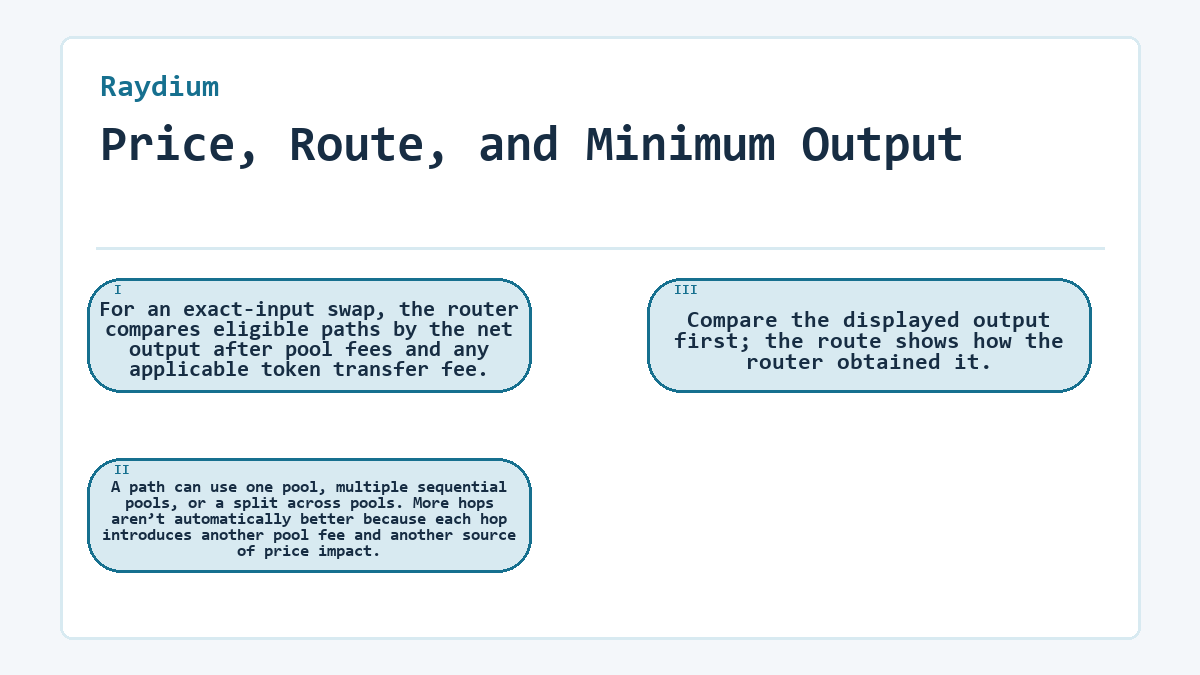
For an exact-input swap, the router compares eligible paths by the net output after pool fees and any applicable token transfer fee. A path can use one pool, multiple sequential pools, or a split across pools. More hops aren’t automatically better because each hop introduces another pool fee and another source of price impact. Compare the displayed output first; the route shows how the router obtained it.
A Hypothetical Quote With a Defined Floor
Assume a hypothetical exact-input request spends 2.72 SOL for a hypothetical quote of 401.37 RAY. The hypothetical slippage tolerance is 0.6%, and the hypothetical priority fee is the auto-selected value displayed at authorization. Every numerical input in this example is illustrative, not a live market value.
The minimum received amount is 401.37 × (1 - 0.006), or 398.96178 RAY before display rounding. Check the mint identities and available SOL first, then review the route, output floor, and transaction preview. After signing, a successful record and an output balance increase at or above the enforced floor provide the receiving-state proof. If the quote refreshes before authorization, its new output and minimum replace the earlier hypothetical values.
Slippage tolerance defines the worst acceptable movement between quoting and execution. A tighter limit offers a firmer floor but can reject a trade after ordinary market movement. A wider limit allows more movement and can permit a worse fill. Priority fees affect the transaction’s chance of timely inclusion during congestion; they don’t improve the pool price.
Pool Design Shapes Quotes and Liquidity Positions
Pool design changes how liquidity is distributed, how a quote responds to trade size, and what a liquidity provider must manage. Raydium routes across several pool generations rather than treating every reserve pair alike.
Constant-Product Pools
Constant-product market makers use the relationship x × y = k to price trades from two token reserves. CPMM is the standard design for new constant-product pools and has no order-book dependency. AMM v4 also uses constant-product pricing and remains operational for existing pools, although its former OpenBook integration has been deactivated. Deeper reserves generally absorb a given trade with less price impact.
Concentrated Liquidity
Concentrated liquidity market maker pools, or CLMM pools, place liquidity within selected price ranges. Active liquidity can produce a stronger quote than the same capital spread across every possible price. Its owner needs to monitor the selected range. Once the market moves outside the chosen range, that liquidity becomes inactive for trades until the price returns or the position is changed.
Fees, Incentives, and Position Risk
Liquidity providers can receive a share of swap fees, and some pools add token incentives through farms or native reward streams. The mechanics differ by pool type: fungible LP tokens represent shares in constant-product pools, while CLMM positions are represented separately and track their own range. Fees and rewards don’t remove impermanent loss, which is the difference between an LP position’s value and the value of simply holding the deposited tokens. Available incentives and their rates can change.
Token Launches Follow a Separate Market Path
LaunchLab handles a different stage of token trading from an ordinary pool swap. A creator configures a launch, and early trades can occur against a bonding curve whose settings govern price and graduation. Buyers should inspect the mint, curve state, fee settings, and graduation conditions because a token name or image doesn’t establish identity or quality.
A LaunchLab market starts on a bonding curve and moves its liquidity into a Raydium pool after reaching its configured graduation threshold. Before graduation, the curve is the relevant market state. After migration, normal pool routing takes over. The post-migration pool and treatment of liquidity depend on the launch configuration, so graduation alone doesn’t prove depth, stability, or continued demand.
Perpetuals Stay Outside the Spot Route
Perpetual markets create leveraged positions rather than exchanging one spot token balance for another. Their order types, collateral rules, funding, margin, and liquidation exposure therefore require a separate decision. A spot quote can’t be used to infer the cost or risk of a perpetual position.
Raydium Perps is a separate interface powered by Orderly Network, rather than a position created in Raydium’s spot pools. Its live leverage caps, collateral limits, fees, and risk parameters may vary by market. A user choosing between spot and perpetual exposure should first decide whether the intended exit is an owned token balance or the closure of a leveraged contract.
Failed Swaps Need a Status Check Before Retry
Check a failed or unclear swap’s transaction status before signing another transaction. Retrying without that distinction can create an unintended second exchange.
Slippage Rejection
A slippage rejection means execution couldn’t meet the minimum output encoded in the transaction. The swap doesn’t settle when that condition fails. A fresh quote may show whether the price moved, liquidity changed, or another route became preferable. Reducing the input can lower price impact. Increasing tolerance changes the accepted floor and should follow a review of the new minimum, not serve as an automatic retry.
Congestion and Stale State
Congestion can leave a transaction unconfirmed until it expires, while a stale route can refer to pool data that changed after quoting. The transaction signature should be checked before rebuilding the request. A fresh quote replaces stale pool state. Raising the priority fee may improve inclusion under congestion, but it can’t repair an invalid pool account or change the quoted exchange rate.
Balance and Transaction Evidence
If the transaction succeeded but the wallet display didn’t change, inspect its token accounts before trying another swap. The output token may be hidden, or its associated token account may have just been created. Check the mint and balance change recorded for the wallet. If the transaction failed, the input and output shouldn’t be reconciled as a completed exchange, although a network fee may still have been charged. Once success is confirmed, locate the received balance instead of resubmitting the trade.
Raydium: what people ask
-
Do I Need RAY to Make a Raydium Spot Swap?
- No, RAY isn’t required merely because the swap uses Raydium. The wallet needs the selected input token and enough SOL to cover Solana transaction costs, including any chosen priority fee. RAY is needed only when it is itself the input asset or another transaction specifically requires it.
-
Which Token-2022 Assets Can Raydium Swap?
- A Token-2022 asset can be swapped when a compatible CPMM or CLMM pool exists and the mint’s extensions are supported by that pool program. AMM v4 doesn’t support Token-2022 mints. Transfer-fee settings can also change the net amount received, so the quote and minimum output need to reflect them.
-
What Happens If Two Tokens Share the Same Ticker?
- The mint address distinguishes the tokens because a ticker and logo aren’t unique identifiers on Solana. Selecting the wrong mint creates a request for a different asset, even if the interface displays the same symbol. Confirm both mint addresses before accepting the route or authorizing the transaction.
-
Is It Possible to Cancel a Raydium Swap After Signing?
- A settled Solana swap can’t be canceled or reversed through the interface. A signed transaction may still be pending, expired, failed, or successful, so check its recorded status before taking further action. Submitting another swap while the first remains uncertain can produce two executions if both eventually land.
-
Does Raydium Support exact-output Swaps?
- Yes, an exact-output request sets the amount the wallet should receive and calculates the required input. The input estimate can change as pool state changes, so review the updated spending limit and transaction preview before signing. Exact-input swaps reverse those roles by fixing the amount spent and calculating output.
-
Is AMM v4 Still Active on Raydium?
- Yes, AMM v4 remains operational and existing pools can still serve swaps and liquidity positions. Its former OpenBook connection has been deactivated, so current swaps use the pool curve. CPMM is the preferred constant-product design for new pools, but that recommendation didn’t automatically close existing AMM v4 pools.
-
When Does a Swap Create a New Token Account?
- A transaction may create an associated token account when the wallet doesn’t already have one for the output mint. That account creation can increase the SOL required because it needs a rent-exempt balance as well as transaction fees. Some wallets don’t display the new account until their token list refreshes.
-
Are Tokens in Raydium Pools Verified by the Protocol?
- No, permissionless pool or launch availability doesn’t certify a token’s identity, security, or value. The mint address remains the primary identity check. Review the specific mint, its authorities and transfer behavior, the available liquidity, and the transaction contents instead of relying on a name, ticker, logo, or pool listing.