 Raydium
 liquidity pools: First-Deposit Checks, Pool Types, and Position Evidence
Raydium liquidity pools require more than matching token tickers before a first deposit. Confirm both mint addresses, identify whether the position uses CPMM, CLMM, or the older AMM v4 design, and read the pool’s fee setting, deposit ratio, and transaction preview. CPMM and AMM v4 deposits stay active across the full price curve and return fungible LP tokens. CLMM concentrates capital inside a chosen range and creates a position NFT; outside that range, it stops earning swap fees and shifts toward one token. Keep SOL available for account and transaction costs, sign only the reviewed instruction, and verify the resulting LP token or position NFT.
Key takeaway: Before depositing, match both token mints and the pool type, then require a successful transaction plus the expected LP position.
Pool Type Sets the Position’s First Requirements
Pool type determines what must be deposited, how fees accrue, what the wallet receives, and how much management follows. Those differences should be settled before comparing displayed yield figures.
CPMM Full-Range Liquidity
CPMM accepts the two pool assets at its current ratio and spreads the deposit across the complete constant-product curve. CPMM positions are represented by fungible LP tokens. Trading fees allocated to liquidity providers remain in the reserves, so withdrawing LP tokens later returns a proportional share of the pool’s then-current assets. Full-range exposure removes the need to select boundaries, but it doesn’t remove impermanent loss when the two assets diverge in price.
CLMM Ranged Liquidity
CLMM asks for lower and upper price boundaries before creating a position NFT. The selected range controls the required token mix and where the capital is available to swaps. A narrower range concentrates more liquidity near the current price, but it can leave active status sooner. This structure suits a provider willing to monitor the position; it isn’t simply a higher-yield version of CPMM.
Existing AMM v4 Pools
AMM v4 remains relevant when an established pair already has liquidity in that program. Its LP position is also represented by fungible tokens, but its program and accounting differ from CPMM. Read the pool-type label rather than assuming every full-range pool uses the same contract. A first deposit shouldn’t be used to create fragmented exposure across pool versions without a clear reason.
Mint Identity Comes Before the Deposit Amount
Mint identity distinguishes the intended assets from tokens sharing the same name, ticker, or image. Compare the complete mint address for each side with the assets you mean to deposit. A familiar symbol or interface badge can help recognition, but neither replaces the address. The pool identifier matters too because one pair can have several pools using different programs, fee configurations, or CLMM ranges.
Token behavior may also alter the deposit. Supported Token-2022 mints can carry transfer fees, which reduce the quantity reaching a vault even when the wallet sends the requested gross amount. Other extensions may make a mint unsuitable for a given pool program. A transfer-fee warning or an unexpected net amount belongs in the decision before signing, not in a later estimate of investment performance.
CLMM Range Placement Controls Active Exposure
Range placement determines whether a CLMM position begins active and how its two assets are allocated. Read the units shown for both boundaries because reversing the displayed price pair can reverse the apparent meaning of the upper and lower values. The current price should sit where the intended exposure calls for it, not merely somewhere inside a wide default range.
A CLMM position earns swap fees only while the current price remains inside its selected range. If the price crosses one boundary, the position becomes out of range, and its liquidity consists entirely of one asset. Price can later re-enter the same range and reactivate the liquidity. Until then, leaving the position untouched doesn’t restore fee generation.
Impermanent loss compares the position’s value with holding the same starting assets outside the pool. It isn’t a separate charge shown in the transaction preview. A narrow range can amplify that divergence because swaps convert the position more quickly as price travels through the range. Removing liquidity ends the exposure at its current composition, so the word "impermanent" doesn’t promise a recovery.
Pool, Network, and Token Fees Affect Position Economics
A new position is affected by pool trading fees paid by swappers, Solana transaction and account costs, and possible token transfer fees. Keeping the layers separate prevents a quoted fee or yield figure from standing in for the total effect.
Pool Trading Fees
Pool trading fees are charged on swaps; the deposit itself neither pays nor guarantees them. The liquidity-provider share depends on the applicable program and configuration, while actual earnings depend on trading volume, position share, and, for CLMM, time in range. A higher fee tier can produce less revenue if it attracts less volume, so the tier alone doesn’t establish the better pool.
Network and Account Costs
Solana charges for the transactions used to open, adjust, collect from, or close a position. Priority fees can add to that cost during congestion. Creating required token accounts or CLMM position accounts may also require rent-exempt balances. The deposit wallet therefore needs enough SOL beyond the two assets, including room for a failed transaction or a later withdrawal.
Token-Level Transfer Fees
Transfer-fee tokens can deduct value when assets move into or out of a pool. That mechanism is separate from the pool’s swap fee and from Solana’s network fee. Review the gross amount leaving the wallet and the net amount credited to the position. If the interface can’t make that difference clear, the first deposit lacks a reliable starting basis.
Quote Freshness Defines the Signing Boundary
A deposit quote is a snapshot of the pool ratio, not a reservation. Another swap can change the required asset mix before the wallet signs. If movement exceeds the permitted deposit tolerance, the transaction may fail rather than open the position on materially different terms. That tolerance is a failure boundary; it doesn’t guarantee a position’s future value.
The final preview should still identify the same mints, pool, program, requested amounts, and expected position type previously reviewed. For CPMM, compare the LP-token estimate and displayed pool share. For CLMM, recheck the selected boundaries, current range status, and required token mix. Repeated failure calls for a fresh quote and a comparison of changed fields, not an automatic increase in tolerance.
A Bounded CPMM Deposit With Verifiable Evidence
This hypothetical example uses an existing CPMM pool and invented values. Every amount and displayed result is hypothetical: the preview requests 128.8 units of the deposit token and 746.3 units of the paired token, while estimating 36.42 LP tokens. The reader has already matched both mint addresses, recorded the pool identifier, and reserved separate SOL for transaction and account costs.
The wallet request is the commitment point. Its token movements, pool identifier, and amounts must match the reviewed preview before signing. In the completed branch, the transaction record reports success and the wallet receives 36.42 LP tokens, matching the final preview. Those records confirm the deposit occurred; they don’t promise a return.
If the transaction fails, the LP balance doesn’t appear, or the instruction changes before approval, the reader stops without submitting a second deposit. A refreshed pool state and a new quote must explain the difference before another signature.
Authorization and Position Evidence Close the First Action
Wallet approval should cover the specific deposit instructions and expected asset movements. Connecting a wallet or signing a normal transaction never requires exposing its seed phrase. An unexplained request to transfer another asset, grant unrelated authority, or interact with a different pool changes the action and should remain unsigned.
Transaction status provides the first completion signal, but the resulting position provides the second. A successful CPMM or AMM v4 deposit should produce the expected LP-token balance. A successful CLMM opening should produce a position NFT with the selected boundaries and an observable range state. The portfolio display can help locate either position, although the on-chain transaction and wallet balances remain useful when an interface is slow to refresh.
A pending or unclear submission isn’t evidence of failure. Check its final status before retrying because a duplicate deposit can create a larger position than intended. If the record shows failure, a fresh quote may be used; if it shows success, reconcile the received position before making another change.
Position Care Differs After the Deposit
Position care begins with preserving the asset representing ownership and understanding where earnings accumulate. CPMM and AMM v4 use fungible LP tokens, while CLMM uses a position NFT and separate fee collection.
CPMM and AMM v4 LP Tokens and Embedded Fees
CPMM and AMM v4 LP tokens represent proportional claims on their respective pool reserves. Fees allocated to LPs remain in those reserves, so there is no separate fee-collection step for the basic position. Transferring or staking the LP tokens can move control or custody of the claim away from the ordinary wallet balance. A future withdrawal returns the owner’s pro-rata share of the reserves at that time, not the original deposit quantities.
CLMM Fees, Ranges, and Rewards
CLMM fees accrue to the individual position and don’t compound unless they are collected and added back as liquidity. The position NFT, its range, unclaimed fees, and any separate reward stream should be tracked as distinct parts of the position. Collecting fees doesn’t automatically recenter an out-of-range position. Changing exposure requires decreasing liquidity, choosing a new range, and opening or increasing the intended position through separate authorized actions.
Incentive rewards aren’t the same as trading fees. A pool may have no active reward stream, and an existing stream can have its own schedule. Displayed yield estimates can change with volume, liquidity, token prices, emissions, and time in range. None of those figures replaces the transaction record or position state as proof of the first deposit.
Unresolved Mismatches Require a Clean Stop
An unclear mint address, unfamiliar pool program, unexpected transfer fee, or unexplained one-sided CLMM allocation is enough to pause before signing. The same applies when the remaining SOL balance can’t cover account creation, network costs, and a later exit. These aren’t minor interface details; each one changes the asset, mechanism, cost, or recoverability of the position.
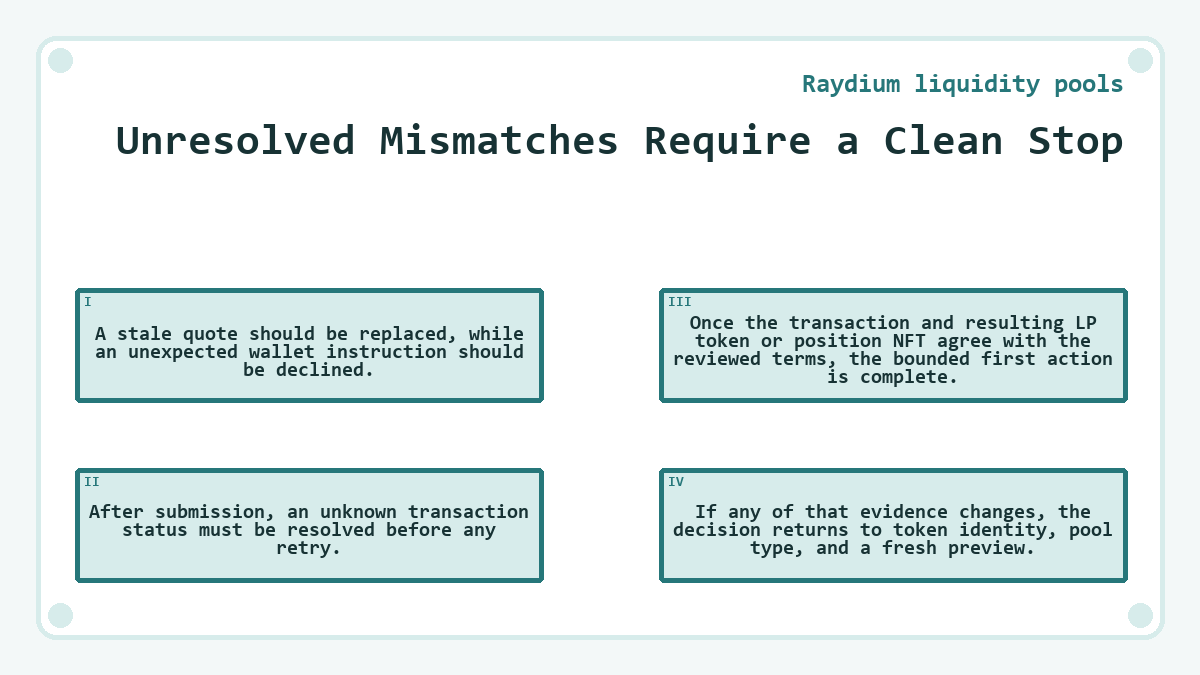
A stale quote should be replaced, while an unexpected wallet instruction should be declined. After submission, an unknown transaction status must be resolved before any retry. Once the transaction and resulting LP token or position NFT agree with the reviewed terms, the bounded first action is complete. If any of that evidence changes, the decision returns to token identity, pool type, and a fresh preview.
Raydium liquidity pools: what people ask
Can a Raydium Liquidity Deposit Be Canceled After Signing?
A confirmed liquidity deposit can’t be canceled or reversed as the same transaction. Before signing, the wallet request can be declined without moving the deposit assets. After submission, first determine whether the transaction succeeded, failed, or remains pending. If it succeeded, leaving the pool requires a separate withdrawal transaction, and the assets returned will reflect the position’s current composition rather than automatically recreating the original deposit.
Does Withdrawing Liquidity Return the Original Token Amounts?
Withdrawing liquidity returns the position’s share in its current composition, not necessarily the quantities originally deposited. CPMM and AMM v4 withdrawals follow their pool’s then-current reserve ratio. CLMM withdrawals depend on the current price relative to the selected range and may be mostly or entirely one token. Unclaimed CLMM fees can also require collection. Price movement, swaps, transfer fees, and rounding can all affect the balances arriving in the wallet.
Are Liquidity Incentives Included in trading-fee Earnings?
Liquidity incentives and trading fees are separate sources of tokens. Trading fees arise when swaps use the pool and are allocated under its program rules. Incentives come from a distinct reward schedule and may not exist for a particular position. Their availability, emission rate, and ending conditions can change independently of swap activity. Evaluate each component separately because a displayed combined yield can hide whether the return depends on temporary rewards.
Can a Token-2022 Transfer Fee Reduce a Liquidity Deposit?
A supported Token-2022 asset can deduct a transfer fee before the pool receives the tokens. The wallet may therefore send a larger gross amount than the position receives as its net deposit. Another deduction may apply when tokens later leave the pool if the mint’s transfer-fee configuration calls for it. Review the transaction preview’s gross and net amounts instead of treating the token-level deduction as a Raydium trading fee.
When Does an out-of-range CLMM Position Begin Earning Fees Again?
An out-of-range CLMM position can resume earning swap fees when the pool price moves back inside its existing lower and upper boundaries. The same position doesn’t need to be recreated solely for that re-entry. While the price remains outside, the position’s liquidity is inactive for swaps and consists entirely of one asset. A provider can wait for re-entry or reposition through separate liquidity-removal and range-selection transactions.